
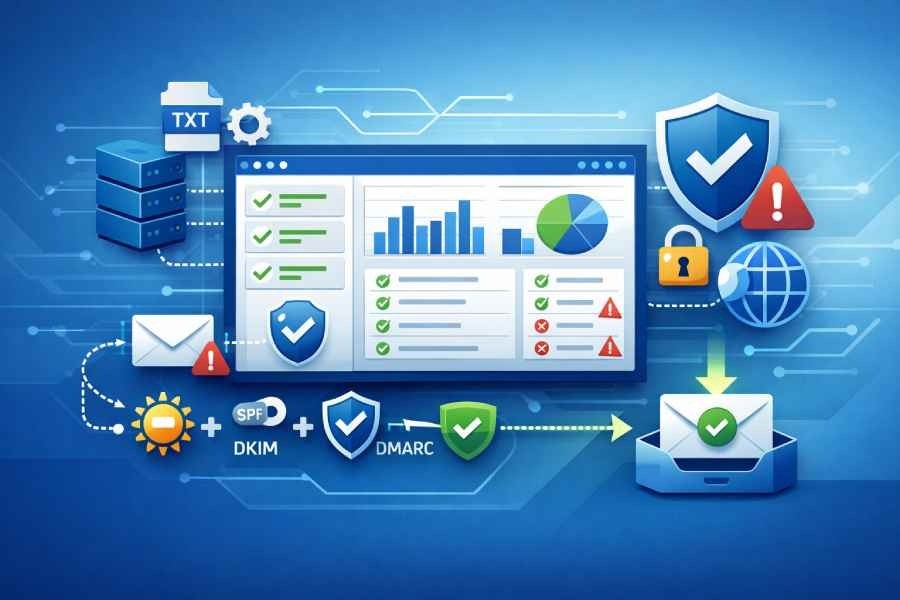
Email has emerged as a vital communication tool in the business world, yet it has also become a frequent target for cybercriminals. Incidents of phishing, spoofing, and domain impersonation are on the rise, jeopardizing both organizations and their clients. Attackers often disguise their emails as coming from legitimate sources to deceive recipients into disclosing sensitive information or downloading harmful files.
This is where DMARC analysis tools become essential. These tools assist organizations in monitoring, analyzing, and applying email authentication policies to safeguard their domains against misuse. By offering valuable insights into email authentication metrics, DMARC analyzers enable businesses to identify unauthorized senders, enhance email deliverability, and bolster their overall email security strategy.
Understanding DMARC and Email Authentication
What is DMARC?
DMARC (Domain-based Message Authentication, Reporting, and Conformance) is a protocol designed for validating email authenticity, aimed at safeguarding domains against spoofing threats. It operates in conjunction with two other authentication methods:
- SPF (Sender Policy Framework): ensures that an email server has permission to send emails on behalf of a domain.
- DKIM (DomainKeys Identified Mail): employs cryptographic signatures to verify that the email’s content remains unchanged.
DMARC enhances SPF and DKIM by introducing mechanisms for policy enforcement and detailed reporting. This allows domain owners to dictate how recipient mail servers should respond to emails that do not pass authentication checks.
Why DMARC is Important
Adopting DMARC offers numerous advantages for businesses:
- Stops malicious actors from sending deceptive emails that appear to come from your domain.
- Boosts trust and reliability among recipients.
- Increases the likelihood of successful email delivery.
- Offers insights into who is authorized to send emails on your domain’s behalf.
- Fortifies overall cybersecurity measures.
Nevertheless, setting up and maintaining DMARC policies can be intricate without the right resources. This is why DMARC analysis tools are crucial.
What is a DMARC Analyzer Tool?
A DMARC analysis tool serves as a platform that gathers, interprets, and displays reports produced by email servers regarding DMARC. These reports offer critical insights into email authentication outcomes and the origins of email sending.
DMARC analyzers transform intricate XML reports into user-friendly dashboards and analytics. This functionality aids domain owners in tracking their authentication performance and swiftly detecting possible risks.
Key Functions of DMARC Analyzer Tools
DMARC analysis tools generally offer a variety of essential functions:
- Consolidation and examination of DMARC reports
- Monitoring of authentication processes
- Detection of threats
- Optimization of policies
- Identification of email sources
By automating these processes, DMARC analyzers significantly simplify the task for organizations to uphold secure and dependable email systems.
How DMARC Analyzer Tools Work
DMARC Reporting Process
When a DMARC policy is set up for a domain, email receivers produce two kinds of reports:
- Aggregate Reports (RUA): These offer a summary of email authentication activities.
- Forensic Reports (RUF): These deliver in-depth details on specific messages that have failed authentication.
Typically, these reports are transmitted to the domain owner in XML format.
Data Processing and Visualization
DMARC analysis tools gather reports and execute various tasks:
- Report Compilation: Gather data from different email service providers.
- Data Conversion: Transforms XML data into easily understandable formats.
- Evaluation: Detects authentication errors and unusual behavior.
- Data Representation: Presents findings with visual dashboards and charts.
- Notifications: Alerts system administrators to possible security risks.
This automated approach enables organizations to identify problems more swiftly than if they were to assess reports by hand.
Key Features of DMARC Analyzer Tools
1. Comprehensive Reporting Dashboards
A key advantage of DMARC analyzer tools lies in their graphical dashboards. These interfaces offer a straightforward summary of authentication outcomes, displaying:
- Sources of email transmissions
- Success and failure rates for SPF and DKIM
- Trends in email volume
- Locations from which emails are sent
This information enables organizations to swiftly pinpoint both genuine and questionable email behavior.
2. Threat Detection and Security Monitoring
DMARC analyzers play a crucial role in identifying harmful actions like domain spoofing and phishing. By examining instances of authentication failures, these tools can reveal:
- Unapproved sender servers
- Questionable IP addresses
- Deceptive email campaigns
Swift identification enables companies to react promptly, mitigating possible harm.
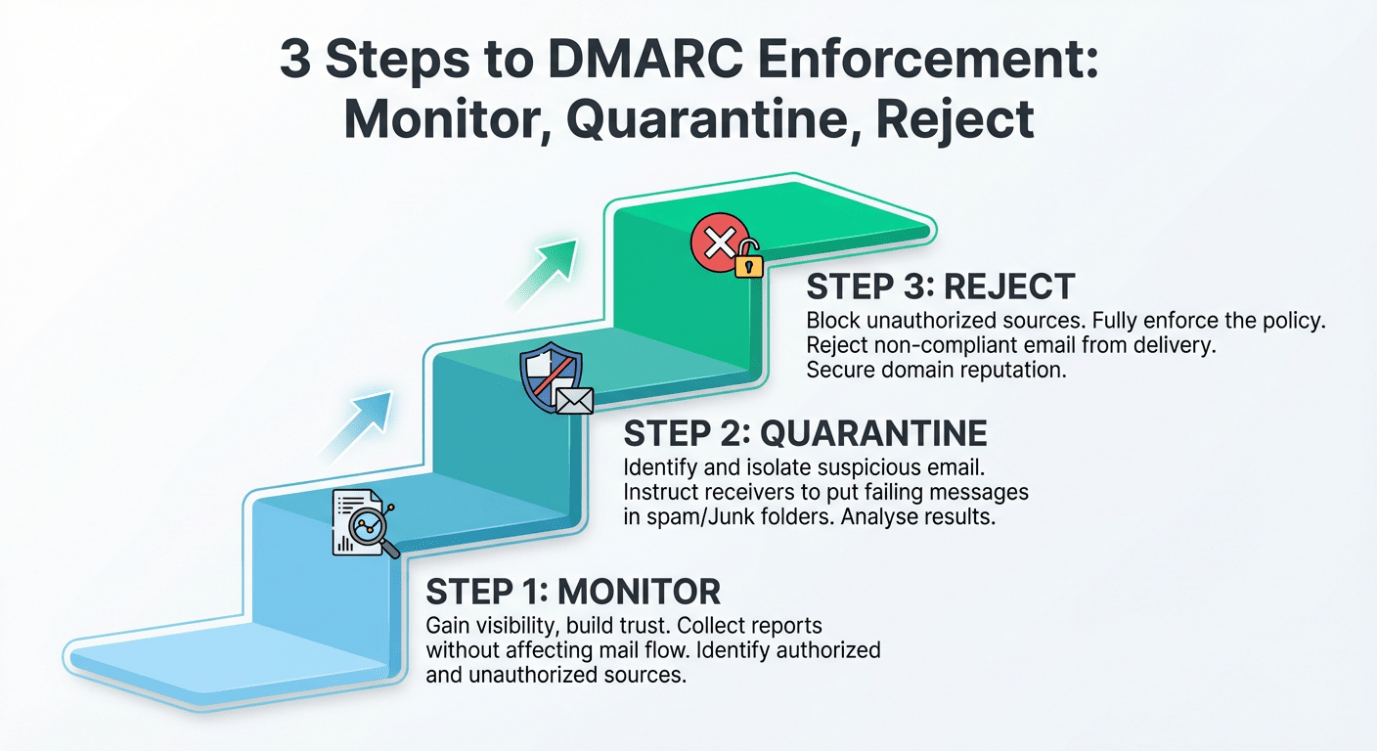
3. DMARC Policy Management
DMARC analysis tools support administrators in establishing and modifying DMARC policies, which dictate how email servers should handle messages that do not pass authentication checks.
- None: Observe email authentication without preventing delivery.
- Quarantine: Redirect questionable emails to spam directories.
- Reject: Deny delivery of unauthorized emails entirely.
These DMARC tools enable organizations to move securely from a monitoring phase to implementing stricter enforcement measures.
4. Email Source Identification
Numerous companies rely on various services for email communication, such as marketing tools, customer relationship management (CRM) systems, and providers for transactional emails.
DMARC analyzers detect all email-sending sources linked to a domain, aiding organizations in verifying that every authorized sender is correctly authenticated.
5. Automated Alerts and Notifications
It’s not feasible for security teams to oversee email traffic 24/7. To address this challenge, DMARC analyzer tools provide notifications when they detect any irregular activities.
- Abrupt increases in authentication failures
- Emergence of unfamiliar sending sources
- Possible phishing attempts
- Incorrectly set authentication configurations
Such proactive oversight is essential for ensuring ongoing email security.
Benefits of Using DMARC Analyzer Tools
Improved Email Deliverability
Email services are progressively using authentication methods to verify the legitimacy of messages. Domains that have robust DMARC setups tend to enjoy improved chances of landing in the inbox.
DMARC analysis tools are useful for spotting authentication problems that could lead to emails being marked as spam.
Stronger Protection Against Phishing
Attackers frequently disguise themselves as reputable domains during phishing assaults. To safeguard against this, companies can implement DMARC policies and actively track reports, which helps prevent any unauthorized usage of their domain names.
This greatly lowers the chances of phishing attempts aimed at staff or clients.
Simplified DMARC Implementation
Setting up DMARC can be difficult, particularly for companies that utilize various email services. DMARC analysis tools make this task easier by offering straightforward instructions and insightful analytics.
These tools assist administrators in identifying which email sources require authentication and how to properly configure the policies.
Greater Visibility Into Email Ecosystems
Numerous organizations lack awareness of all the systems that dispatch emails from their domains. DMARC analyzers offer comprehensive insights into email activity, uncovering obscure or overlooked sending sources.
This enables companies to exercise improved oversight over their email operations.
Enhanced Brand Reputation
Email spoofing poses a significant threat to brand integrity. When cybercriminals dispatch fake emails appearing to come from a company’s domain, it can erode customer trust in that brand.
DMARC analyzers assist businesses in safeguarding their reputation by verifying that only legitimate senders have permission to utilize their domain.

Best Practices for Using DMARC Analyzer Tools
Start with Monitoring Mode
At the outset of DMARC implementation, it is advisable to start with the p=none policy. This enables organizations to gather data and review authentication outcomes without impacting their email delivery.
Using DMARC analyzers can assist in understanding these reports and pinpointing any required configuration adjustments.
Identify All Legitimate Email Sources
Prior to implementing stringent DMARC policies, companies should verify that all authorized sending services are correctly authenticated with SPF and DKIM.
Neglecting this step might lead to the blockage of valid emails.
Gradually Enforce Stronger Policies
After confirming the authentication settings, organizations ought to progressively adopt stricter DMARC policies:
- Monitoring phase (p=none)
- Quarantine stage (p=quarantine)
- Rejection point (p=reject)
Utilizing DMARC analysis tools offers valuable insights for facilitating these changes securely.
Regularly Review Reports
Email systems transform as new tools and services become available. Consistently checking DMARC reports helps maintain the accuracy of authentication settings.
Using DMARC analyzers simplifies this continuous oversight.
Integrate with Security Strategies
DMARC ought to be integrated into a comprehensive email security plan that also encompasses staff training, tools for detecting phishing attempts, and secure email gateways.
By combining these strategies, organizations can enhance their defense against cyber threats.
Challenges Without DMARC Analyzer Tools
Overseeing DMARC settings manually can be quite challenging. The raw DMARC reports usually arrive in intricate XML formats that are tough to decipher without the right tools.
Without a dedicated DMARC analysis tool, organizations may encounter multiple issues, such as:
- Struggling to understand extensive report data
- Restricted insight into where emails are being sent from
- Delayed detection of phishing attempts
- Higher likelihood of policy misconfigurations
- Decreased capability to enhance email deliverability
These issues underscore the necessity of employing automated tools for effective DMARC management.
Email continues to be a major communication method for businesses, making it a key target for cyber criminals. Safeguarding domains against spoofing and phishing necessitates robust authentication protocols and ongoing vigilance.
DMARC analysis tools offer essential visibility, analytics, and automation for managing email authentication effectively. By converting intricate DMARC reports into practical insights, these tools assist organizations in pinpointing threats, enhancing deliverability, and preserving customer trust.
By implementing DMARC with DMARCreport analysis tools, businesses can effectively monitor their email ecosystem and prevent unauthorized use of their domain. DMARCreport provides clear visibility into authentication results, helping organizations detect spoofing attempts and identify configuration issues. As email security standards continue to evolve, organizations that rely on DMARCreport for DMARC monitoring and enforcement will be better positioned to protect their brand reputation, users, and overall digital communications.