
Back to: Angular Tutorials For Beginners and Professionals
Angular Two-Way Data Binding with Examples
In this article, I will discuss Angular Two-Way Data Binding with examples. Please read our previous article on Angular Event Binding with Examples. Modern web applications are Not Static Web Pages. They are State-Driven Systems where:
- The Application State (Data) lives in TypeScript (Component)
- The User Interacts with HTML Elements (View)
- Both must stay Perfectly Synchronized
So far in Angular, we have handled this synchronization in one direction at a time:
- Component → View
-
- Interpolation
- Property Binding
- Attribute Binding
- Class Binding
- Style Binding
-
- View → Component
-
- Event Binding
-
This separation is Architecturally Correct, but it creates unnecessary complexity in most common situations: When the user modifies a value in the UI, the component must update immediately, and when the component updates, the UI must reflect that change instantly.
Without a higher-level abstraction, developers must manually connect data flows in both directions, resulting in repeated, unnecessary code. Angular Two-Way Data Binding exists to simplify this common scenario while keeping data flow predictable.
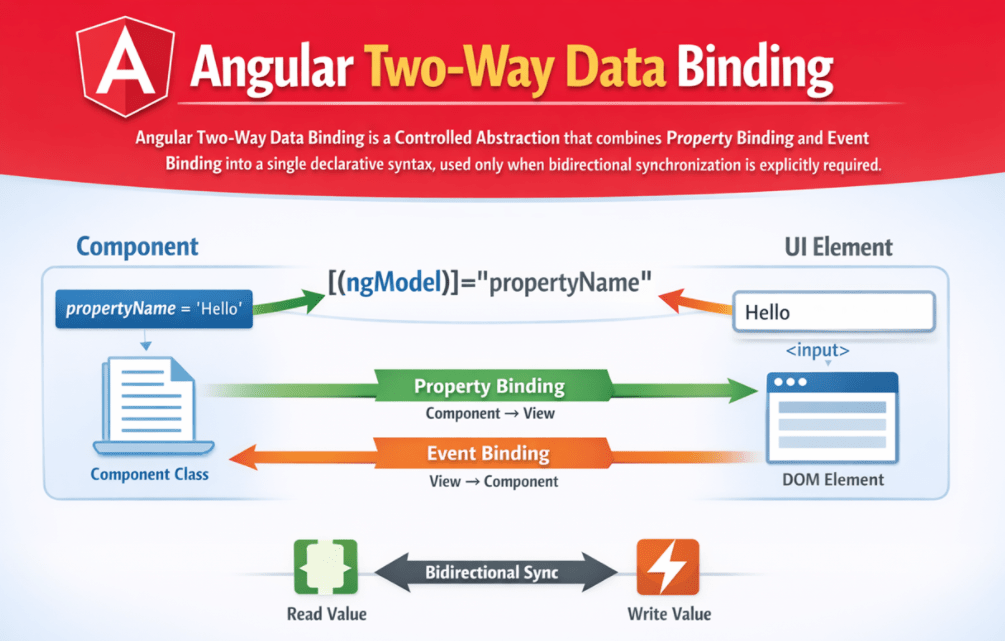
What Is Angular Two-Way Data Binding?
Angular Two-Way Data Binding is not a separate binding system.
- It is not magic.
- It is not automatic synchronization of everything.
- It is not the default Angular behaviour.
Angular Two-Way Data Binding is a Controlled Abstraction that combines Property Binding and Event Binding into a single declarative syntax, used only when bidirectional synchronization is explicitly required.
- Property Binding: Property Binding is used to display data from the component in the user interface. It takes a value from the component and sets it on an HTML element so that whenever the component data changes, the UI automatically shows the updated value.
- Event Binding: Event Binding is used to notify the component when the user interacts with the UI. It listens to actions such as typing, clicking, or selecting, and allows the component to respond by updating its data accordingly.
The Syntax of Angular Two-Way Data Binding
Angular provides a Special Combined Syntax to keep a component property and a UI element synchronized automatically. This mechanism is called Two-Way Data Binding.
Syntax: [(ngModel)]=”propertyName”
What This Means
- propertyName is a variable defined in the component class.
- The UI displays the value of propertyName.
- When the user changes the UI value, propertyName is updated automatically.
- Both the UI and the component always stay synchronized.
In simple words: Whatever value exists in propertyName appears in the UI, and whatever the user enters in the UI goes back into propertyName.
Understanding the Symbols in the Syntax
Let us break the syntax into parts.
Property Binding – []
[property]=”value”
- Sends data from Component → View
- Used to display a component value in the UI
Event Binding – ()
(event)=”handler()”
- Sends data from View → Component
- Used to notify the component when something changes in the UI
Two-Way Binding – [()]
- Combines Property Binding and Event Binding
- Allows data to move in both directions
So:
[(ngModel)]=”propertyName”
Means:
- Read the value from propertyName and show it in the UI
- Update propertyName whenever the user changes the UI value
Note: In Two-Way Data Binding, we do not define any handler method in the component class. However, Event Binding requires a handler; where is the handler in two-way binding? In two-way data binding, the handler is NOT a method. The handler is a simple assignment expression generated by Angular.
How Angular Treats [(ngModel)] Internally?
Angular does not treat two-way binding as a special or separate feature. When Angular sees:
- [(ngModel)]=”propertyName”
It internally splits it into Two Normal Bindings:
- Property Binding: [ngModel]=”propertyName”
- Event Binding: (ngModelChange)=”propertyName = $event”
We do not write this manually — Angular generates it for us.
Property Binding: [ngModel]=”propertyName” (Component → View)
This line displays data in the UI.
[ngModel]=”propertyName”
What Angular Does Here
- Angular looks at the component class.
- It reads the current value stored in propertyName.
- Using ngModel, Angular assigns that value to the UI element.
In simple terms, Angular is saying: Take the value from propertyName and show it in this input element.
Important Point
- No user interaction is involved here.
- This happens during:
-
- Initial rendering
- Every change detection cycle
-
Result
- The UI always shows the current value of propertyName.
Event Binding: (ngModelChange)=”propertyName = $event” (View → Component)
This line sends changes back to the component.
(ngModelChange)=”propertyName = $event”
What Happens When the User Changes the UI
- The user types or modifies the input value.
- The value inside the UI element changes.
- ngModelChange event is raised.
Angular now receives the new value entered by the user. The $event represents the new value coming from the UI element.
So, this statement: propertyName = $event replaces the value of propertyName with the new value entered by the user. This assignment is the event handler. No method call is required.
What is the ngModel directive in Angular?
The ngModel is an Angular Forms directive (used in template-driven forms) that binds a form control (such as input/select/textarea) to a component property, allowing Angular to read the current value, update the UI, and track the control’s state.
- It enables two-way binding using [(ngModel)] by pairing:
-
- [ngModel] (write component value to the control) and
- (ngModelChange) (emit the new value when the user changes it).
-
- It belongs to Angular’s FormsModule, so it’s mainly used in template-driven forms.
Real-Time Scenario to Understand Angular Two-Way Binding
In a real e-commerce checkout, the page is not just a “display screen”. It is an interactive decision screen where the user continuously changes inputs (quantity, coupon, shipping), and the UI must respond instantly (total amount, payable amount, button enable/disable, progress bar, status badges). That’s why this scenario is perfect for learning Two-Way Data Binding. Because it naturally contains both sides:
- User → UI Interaction (Typing, Selecting, Clicking)
- UI → Automatic Updates (Totals, Discounts, Payment Status, Progress)
What the user can do (Real Checkout Actions)
On this page, the user can:
- Increase / Decrease Quantity using Click Events
- Type Quantity Directly using Two-Way Binding
- Enter the coupon code using Two-Way Binding, then apply using Click
- Select Shipping Option using Two-Way Binding
- Click Pay Now to mark payment completed using Click Events
- Click Place Order to submit the order using the form submit event
What the UI should reflect instantly (Bindings working together)
A real checkout screen must clearly show the current state:
- Paid / Pending Badge (Class Binding)
- Delivery Progress Bar (Style Binding: width %)
- Enable / Disable Buttons (Property Binding)
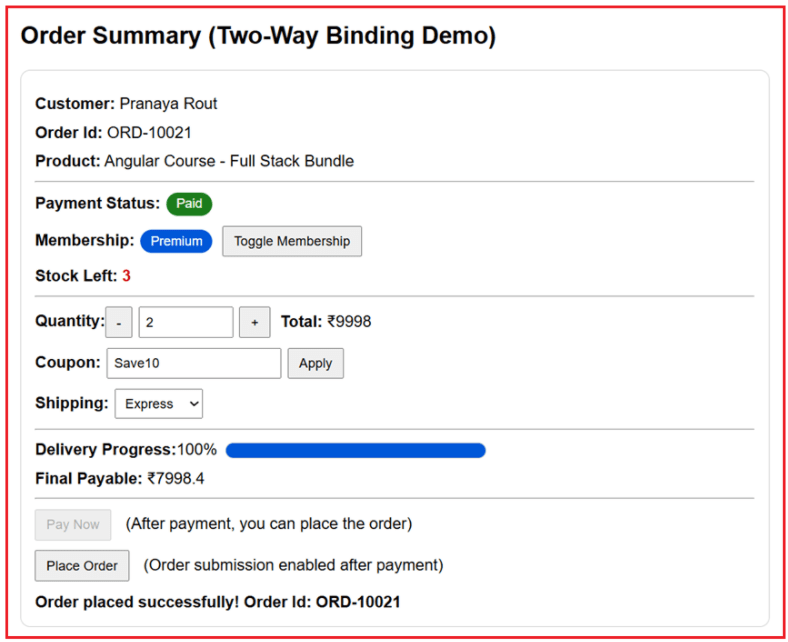
This is exactly what happens in a real-time application: when the component’s state changes, Angular automatically repaints the UI.
Step 1: Create a New Angular App
Run:
- ng new two-way-binding-demo
Choose:
- Stylesheet: CSS
- SSR/SSG: No
- AI tools: None
Then run:
- cd two-way-binding-demo
- ng serve
Open:
- http://localhost:4200
Step 2: src/styles.css
This file is the screen (UI) of the application. It displays the order details and connects the input fields and buttons with the TypeScript file using Angular bindings. It uses [(ngModel)] so that typing in inputs automatically updates the component’s values, and any changes to the component are reflected on the page immediately. Please modify the src/styles.css file as follows.
/* ------------------------------------------------------------
   Page wrapper
   - Applies a readable font across the whole page
   - Adds padding so content doesn't stick to screen edges
   ------------------------------------------------------------ */
.page {
  font-family: Arial, sans-serif; /* Simple, widely available font */
  padding: 16px;                  /* Space around the entire UI */
}

/* ------------------------------------------------------------
   Card container (Order Summary box)
   - Visually groups all order information into one bordered area
   - max-width keeps it readable on large screens
   ------------------------------------------------------------ */
.card {
  border: 1px solid #d0d0d0; /* Light gray border to separate from background */
  border-radius: 10px;       /* Rounded corners for a modern "card" feel */
  padding: 14px;             /* Inner spacing so text doesn't touch border */
  max-width: 720px;          /* Prevents overly wide layout on big screens */
}

/* ------------------------------------------------------------
   Row spacing helper
   - Adds vertical spacing between each logical line/section
   - Keeps HTML clean (avoids adding inline margins everywhere)
   ------------------------------------------------------------ */
.row {
  margin: 10px 0; /* Space above and below each block */
}

/* ------------------------------------------------------------
   Badge base style (common for status labels)
   - Used for Payment Status and Membership
   - Color changes are handled by .paid/.pending/.premium/.regular
   ------------------------------------------------------------ */
.badge {
  display: inline-block; /* Allows padding and rounded corners like a "pill" */
  padding: 4px 10px;     /* Controls badge size */
  border-radius: 999px;  /* Big number => perfect pill shape */
  font-size: 13px;       /* Slightly smaller than normal text */
  margin-left: 6px;      /* Gap after the label text (e.g., "Payment Status:") */
}

/* ------------------------------------------------------------
   Payment status colors (used via Class Binding)
   HTML uses:
   - [class.paid]="isPaymentDone"
   - [class.pending]="!isPaymentDone"
   ------------------------------------------------------------ */
.paid {
  background: #1c7c1c; /* Green implies success/confirmed */
  color: #fff;         /* White text for good contrast on green */
}

.pending {
  background: #ffcc00; /* Yellow implies waiting/attention */
  color: #222;         /* Dark text is easier to read on yellow */
}

/* ------------------------------------------------------------
   Membership colors (used via Class Binding)
   HTML uses:
   - [class.premium]="isPremiumCustomer"
   - [class.regular]="!isPremiumCustomer"
   ------------------------------------------------------------ */
.premium {
  background: #0057d8; /* Blue indicates premium/special tier */
  color: #fff;
}

.regular {
  background: #6c757d; /* Gray indicates normal/basic tier */
  color: #fff;
}

/* ------------------------------------------------------------
   Low stock highlight (used via Class Binding)
   HTML uses:
   - [class.low-stock]="stockLeft <= 5"
   Purpose:
   - Makes low inventory stand out immediately (red + bold)
   ------------------------------------------------------------ */
.low-stock {
  color: #d10000;    /* Red signals warning/urgency */
  font-weight: bold; /* Bold draws attention */
}

/* ------------------------------------------------------------
   Button base styling
   - Adds comfortable padding for click targets
   - cursor pointer gives a "clickable" feel (UX improvement)
   Note:
   - Disabled button style is handled by the browser automatically.
   ------------------------------------------------------------ */
button {
  padding: 6px 10px; /* Comfortable size for clicking */
  cursor: pointer;   /* Shows hand cursor on hover */
}

/* ------------------------------------------------------------
   Input and dropdown styling
   - Adds padding so form controls look clean and readable
   - Keeps UI consistent across inputs and selects
   ------------------------------------------------------------ */
input,
select {
  padding: 6px; /* Comfortable inner spacing */
}

/* ------------------------------------------------------------
   Progress bar container (the "track")
   - This is the outer shell of the progress bar
   - overflow:hidden ensures the inner fill stays inside rounded edges
   ------------------------------------------------------------ */
.progress-box {
  border: 1px solid #ccc;   /* Outline of the progress track */
  border-radius: 8px;       /* Rounded track corners */
  height: 14px;             /* Progress bar height */
  width: 260px;             /* Fixed width for demo consistency */
  overflow: hidden;         /* Keeps inner fill clipped inside the track */
  display: inline-block;    /* Allows it to sit next to the % text */
  vertical-align: middle;   /* Aligns nicely with surrounding text */
  margin-left: 8px;         /* Gap after the "35%" label */
}

/* ------------------------------------------------------------
   Progress fill (the "completed portion")
   - The width is controlled by Angular Style Binding:
     [style.width.%]="deliveryProgressPercent"
   Important:
   - display:block ensures width works as expected inside the span
   ------------------------------------------------------------ */
.progress-fill {
  display: block;         /* Needed so width% applies properly */
  height: 100%;           /* Fill the full height of .progress-box */
  background: #0057d8;    /* Blue fill indicates progress */
}

/* ------------------------------------------------------------
   UI feedback message (action result text)
   - Shows messages after actions like apply coupon, payment, etc.
   - Bold so users notice feedback immediately
   ------------------------------------------------------------ */
.message {
  margin-top: 12px;  /* Space above the message area */
  font-weight: bold; /* Emphasizes success/error feedback */
}
Step 3: src/app/app.ts
This file stores the data and logic for the order summary page. It contains fields such as customer name, product price, quantity, coupon code, shipping option, payment status, and delivery progress. It also has methods that run when the user clicks buttons or changes inputs, and it updates the UI automatically through Angular bindings. Please modify the src/app/app.ts file as follows.
import { Component } from '@angular/core';
import { FormsModule } from '@angular/forms';
// FormsModule is required to use template-driven forms features like [(ngModel)]
// Without this import, Angular will throw: "Can't bind to 'ngModel' ..."

@Component({
  selector: 'app-root',

  // Directives/Pipes used in this component template must be imported here.
  // FormsModule provides ngModel, ngForm, etc.
  imports: [FormsModule],

  // External template file
  templateUrl: './app.html',
})
export class App {

  // 1) DISPLAY DATA (Normally comes from API / logged-in session)
  // Purpose:
  // - These are the "read-only" values we show on the screen.
  // - In real projects, these typically come from backend services.
  customerName: string = 'Pranaya Rout';                   // Customer name shown in summary
  orderId: string = 'ORD-10021';                           // Unique order reference
  productName: string = 'Angular Course - Full Stack Bundle'; // Product name shown in UI
  price: number = 4999;                                    // Per-unit price (₹)

  // 2) TWO-WAY BINDING STATE ([(ngModel)] keeps UI <-> TS synced)
  // Purpose:
  // - These values are changed by the user (typing/selecting).
  // - Two-way binding ensures:
  //   UI changes update TS automatically AND TS changes update UI.
  quantity: number = 1;                // User-selected quantity (default 1)
  couponCode: string = '';             // Coupon typed by the user
  shippingOption: string = 'Standard'; // Default selection in dropdown

  // 3) STATUS FLAGS (Used for Class/Property/Style Binding)
  // Purpose:
  // - These booleans drive visual state (Paid/Pending, Premium/Regular)
  // - Also used to enable/disable buttons in the template.
  isPremiumCustomer: boolean = true;  // Premium users get discount
  isPaymentDone: boolean = false;     // Controls Pay/Place Order flow

  // 4) INVENTORY + DELIVERY (Common dashboard fields)
  // Purpose:
  // - stockLeft can show warnings (low-stock highlighting)
  // - deliveryProgressPercent drives a progress bar UI (0..100)
  stockLeft: number = 3;                 // Inventory left
  deliveryProgressPercent: number = 35;  // Delivery progress percentage

  // 5) UI FEEDBACK MESSAGE (Displayed to user after actions)
  // Purpose:
  // - After any click/input action, show a short message.
  // - This is a typical UX pattern in real checkout flows.
  uiMessage: string = ''; // Example: "Coupon applied", "Quantity updated", etc.

  // 6) HELPER METHODS (Used mainly for display in template)
  // Purpose:
  // - Keep template clean by preparing readable text in TS.
  // - Used via interpolation: {{ getPaymentLabel() }}

  // Returns a human-friendly label for payment status badge.
  getPaymentLabel(): string {
    // If payment completed -> Paid, else -> Pending
    return this.isPaymentDone ? 'Paid' : 'Pending';
  }

  // Returns a human-friendly label for membership badge.
  getMembershipLabel(): string {
    // If premium -> Premium, else -> Regular
    return this.isPremiumCustomer ? 'Premium' : 'Regular';
  }

  // Calculates final payable amount using business rules.
  // Real-time rule:
  // - Premium customers get 20% discount on total amount.
  // This method is displayed in UI as: ₹{{ getFinalPayable() }}
  getFinalPayable(): number {
    const total = this.price * this.quantity;                  // Total = price × quantity
    const discount = this.isPremiumCustomer ? total * 0.2 : 0; // 20% discount for premium users
    return total - discount;                                   // Final amount after discount
  }

  // 7) EVENT HANDLERS (Triggered by user actions in the template)
  // Purpose:
  // - These methods are called via event binding: (click), (submit), etc.
  // - After updating component state, Angular automatically updates the UI.

  // Increase quantity (called by + button)
  // Real-time rule:
  // - E-commerce apps usually cap quantity to avoid unrealistic orders.
  // - Demo cap: max 10.
  increaseQuantity(): void {
    if (this.quantity < 10) {
      this.quantity++; // Update quantity in component state
      this.uiMessage = `Quantity updated to ${this.quantity}.`; // User feedback
    }
  }

  // Decrease quantity (called by - button)
  // Real-time rule:
  // - Quantity should not go below 1.
  decreaseQuantity(): void {
    if (this.quantity > 1) {
      this.quantity--; // Update quantity in component state
      this.uiMessage = `Quantity updated to ${this.quantity}.`; // User feedback
    }
  }

  // Called when quantity changes via [(ngModel)] input typing.
  // Why do we need this even with ngModel?
  // - Because user can type invalid numbers (0, -5, 999, empty, etc.)
  // - We validate and keep the state safe.
  onQuantityChanged(value: number): void {
    const parsed = Number(value); // Convert to number safely

    // Valid range check: 1..10
    if (!Number.isNaN(parsed) && parsed >= 1 && parsed <= 10) {
      this.quantity = parsed; // Accept valid input
      this.uiMessage = `Quantity set to ${this.quantity}.`;
    } else {
      // Reset to safe default and inform the user
      this.quantity = 1;
      this.uiMessage = 'Quantity must be between 1 and 10. Reset to 1.';
    }
  }

  // Apply coupon (called by Apply button or Enter key)
  // Real-world note:
  // - Usually coupon validation happens via API call.
  // - Here we simulate it with a simple rule for learning.
  applyCoupon(): void {
    const code = this.couponCode.trim().toUpperCase();
    // trim() removes extra spaces, toUpperCase() standardizes input

    // Empty coupon => show guidance
    if (code === '') {
      this.uiMessage = 'Please enter a coupon code.';
      return;
    }

    // Demo rule: Only SAVE10 is valid
    if (code === 'SAVE10') {
      this.uiMessage = 'Coupon applied: SAVE10.';
    } else {
      this.uiMessage = `Invalid coupon: ${code}`;
    }
  }

  // Called when shipping dropdown changes.
  // Real-world note:
  // - Shipping selection often affects delivery estimate and charges.
  // - Here we show a confirmation message for learning.
  onShippingChanged(value: string): void {
    this.shippingOption = value; // Update selected option
    this.uiMessage = `Shipping set to: ${this.shippingOption}`;
  }

  // Toggle membership (demo action)
  // Real-world note:
  // - Membership may come from user profile / subscription.
  // - We keep a toggle only for learning how UI changes with state.
  toggleMembership(): void {
    this.isPremiumCustomer = !this.isPremiumCustomer; // Flip boolean
    this.uiMessage = `Membership changed to: ${this.getMembershipLabel()}.`;
  }

  // Pay Now action
  // Real-world behaviour:
  // - Payment success changes the application workflow:
  //   1) Payment badge turns to Paid
  //   2) Pay Now button disables
  //   3) Place Order becomes enabled
  //   4) Progress moves forward
  payNow(): void {
    this.isPaymentDone = true; // Payment marked as completed
    this.uiMessage = `Payment received for ${this.orderId}. You can now place the order.`;

    // Demo: After payment, delivery process advances
    this.deliveryProgressPercent = 60;
  }

  // Place Order action (form submit)
  // Why preventDefault?
  // - HTML forms try to reload the page on submit.
  // - In SPA apps like Angular, we avoid full reload.
  placeOrder(event: Event): void {
    event.preventDefault(); // Stop browser default form submission

    // Safety validation: Don't allow placing order before payment
    if (!this.isPaymentDone) {
      this.uiMessage = 'Please complete payment before placing the order.';
      return;
    }

    // Success scenario
    this.uiMessage = `Order placed successfully! Order Id: ${this.orderId}`;

    // Demo: Mark delivery progress as complete
    this.deliveryProgressPercent = 100;
  }
}
Step 4: src/app/app.html
This file is the screen (UI) of the application. It displays the order details and connects the input fields and buttons with the TypeScript file using Angular bindings. It uses [(ngModel)] so that typing in inputs automatically updates the component’s values, and any changes to the component are reflected on the page immediately. Please modify the src/app/app.html file as follows.
<!-- src/app/app.html -->

<!--
  This page is a Real-Time E-commerce Order Summary demo.
  Goal: Show how Two-Way Data Binding ([(ngModel)]) works along with
  previous bindings we already learned:

  Interpolation        => {{ ... }} (display values)
  Property Binding     => [disabled] (enable/disable buttons)
  Class Binding        => [class.xxx] (apply CSS classes based on state)
  Style Binding        => [style.xxx] (dynamic inline styles)
  Event Binding        => (click), (keyup.enter), (submit), (ngModelChange)
  Two-Way Binding      => [(ngModel)] (UI <-> Component sync)
-->

<div class="page">
  <!-- Page heading (static text) -->
  <h2>Order Summary (Two-Way Binding Demo)</h2>

  <!-- Card container: gives a neat box around the order summary -->
  <div class="card">
    <!-- ----------------------------------------------------------
         1) INTERPOLATION (Component → View)
         - We only display text values from the component.
         - These values usually come from API / session in real apps.
         ---------------------------------------------------------- -->
    <div class="row"><b>Customer:</b> {{ customerName }}</div>
    <div class="row"><b>Order Id:</b> {{ orderId }}</div>
    <div class="row"><b>Product:</b> {{ productName }}</div>

    <hr />

    <!-- ----------------------------------------------------------
         2) CLASS BINDING (Visual State: Paid / Pending)
         - "badge" class is always applied.
         - paid/pending class is applied conditionally based on isPaymentDone.
         - This is how dashboards show status in real apps.
         ---------------------------------------------------------- -->
    <div class="row">
      <b>Payment Status:</b>

      <!--
        If isPaymentDone === true  -> apply class "paid" (green badge)
        If isPaymentDone === false -> apply class "pending" (yellow badge)
      -->
      <span
        class="badge"
        [class.paid]="isPaymentDone"
        [class.pending]="!isPaymentDone"
      >
        <!-- Interpolation calling helper method -->
        {{ getPaymentLabel() }}
      </span>
    </div>

    <!-- ----------------------------------------------------------
         3) CLASS BINDING + EVENT BINDING (Membership Toggle)
         - Membership is shown visually as Premium/Regular badge.
         - Clicking button changes the boolean flag in component.
         ---------------------------------------------------------- -->
    <div class="row">
      <b>Membership:</b>

      <!--
        If isPremiumCustomer === true  -> apply "premium" (blue badge)
        If isPremiumCustomer === false -> apply "regular" (gray badge)
      -->
      <span
        class="badge"
        [class.premium]="isPremiumCustomer"
        [class.regular]="!isPremiumCustomer"
      >
        {{ getMembershipLabel() }}
      </span>

      <!--
        Event Binding:
        Clicking calls toggleMembership() which flips isPremiumCustomer.
        Angular updates badge and final payable automatically.
      -->
      <button
        type="button"
        (click)="toggleMembership()"
        style="margin-left: 10px"
      >
        Toggle Membership
      </button>
    </div>

    <!-- ----------------------------------------------------------
         4) CLASS BINDING (Low Stock Warning)
         - When stock is low (<= 5), highlight stock number in red/bold.
         - We are not hiding anything (no ngIf), only styling.
         ---------------------------------------------------------- -->
    <div class="row">
      <b>Stock Left:</b>

      <!-- Apply "low-stock" class only when stockLeft <= 5 -->
      <span [class.low-stock]="stockLeft <= 5">
        {{ stockLeft }}
      </span>
    </div>

    <hr />

    <!-- ----------------------------------------------------------
         5) TWO-WAY BINDING + PROPERTY + EVENT BINDING (Quantity)
         - [(ngModel)] keeps input and quantity property always in sync.
         - (ngModelChange) is used to validate and keep quantity in range.
         - [disabled] prevents invalid clicks (below 1 / above 10).
         ---------------------------------------------------------- -->
    <div class="row">
      <b>Quantity:</b>

      <!--
        Event Binding:
        Decrease quantity (disabled when quantity is already minimum 1)
        -->
      <button
        type="button"
        (click)="decreaseQuantity()"
        [disabled]="quantity <= 1"
      >
        -
      </button>

      <!--
        Two-Way Binding:
        - If user types, quantity is updated automatically.
        - If TS updates quantity (via +/- buttons), the input updates automatically.

        Why (ngModelChange)?
        - User can type invalid values like 0, -1, 999 etc.
        - We validate and correct via onQuantityChanged().
      -->
      <input
        type="number"
        [(ngModel)]="quantity"
        (ngModelChange)="onQuantityChanged($event)"
        min="1"
        max="10"
        style="width: 80px; margin: 0 6px"
      />

      <!--
        Event Binding:
        Increase quantity (disabled when quantity reaches maximum 10)
        -->
      <button
        type="button"
        (click)="increaseQuantity()"
        [disabled]="quantity >= 10"
      >
        +
      </button>

      <!-- Real-time total calculation -->
      <span style="margin-left: 10px">
        <b>Total:</b> ₹{{ price * quantity }}
      </span>
    </div>

    <!-- ----------------------------------------------------------
         6) TWO-WAY BINDING + EVENT BINDING (Coupon)
         - [(ngModel)] stores user typed coupon into couponCode.
         - (keyup.enter) allows user to press Enter to apply coupon.
         - (click) Apply button triggers same logic.
         ---------------------------------------------------------- -->
    <div class="row">
      <b>Coupon:</b>

      <!-- Two-way binding keeps couponCode updated as user types -->
      <input
        type="text"
        [(ngModel)]="couponCode"
        (keyup.enter)="applyCoupon()"
        style="margin-left: 6px; width: 160px"
      />

      <!-- Click to apply coupon -->
      <button
        type="button"
        (click)="applyCoupon()"
        style="margin-left: 6px"
      >
        Apply
      </button>
    </div>

    <!-- ----------------------------------------------------------
         7) TWO-WAY BINDING + EVENT BINDING (Shipping Dropdown)
         - [(ngModel)] keeps selected dropdown value synced with shippingOption.
         - (ngModelChange) lets us show message/update additional logic.
         ---------------------------------------------------------- -->
    <div class="row">
      <b>Shipping:</b>

      <!-- Two-way binding updates shippingOption automatically -->
      <select
        [(ngModel)]="shippingOption"
        (ngModelChange)="onShippingChanged($event)"
        style="margin-left: 6px"
      >
        <option value="Standard">Standard</option>
        <option value="Express">Express</option>
        <option value="NextDay">Next Day</option>
      </select>
    </div>

    <hr />

    <!-- ----------------------------------------------------------
         8) STYLE BINDING (Delivery Progress Bar)
         - The width of progress-fill depends on deliveryProgressPercent (0..100)
         - This is a classic real-time use case of style binding.
         ---------------------------------------------------------- -->
    <div class="row">
      <b>Delivery Progress:</b>
      <span>{{ deliveryProgressPercent }}%</span>

      <!-- Outer bar track -->
      <span class="progress-box">
        <!-- Inner fill:
             [style.width.%] sets width like 35%, 60%, 100% -->
        <span
          class="progress-fill"
          [style.width.%]="deliveryProgressPercent"
        ></span>
      </span>
    </div>

    <!-- ----------------------------------------------------------
         9) INTERPOLATION WITH METHOD (Business Rule)
         - Premium customers get 20% discount.
         - Value recalculates when quantity or membership changes.
         ---------------------------------------------------------- -->
    <div class="row">
      <b>Final Payable:</b> ₹{{ getFinalPayable() }}
    </div>

    <hr />

    <!-- ----------------------------------------------------------
         10) EVENT + PROPERTY + STYLE BINDING (Pay Now)
         - (click) triggers payNow()
         - [disabled] prevents paying again after success
         - [style.opacity] gives slight visual state guidance
         ---------------------------------------------------------- -->
    <div class="row">
      <button
        type="button"
        (click)="payNow()"
        [disabled]="isPaymentDone"
      >
        Pay Now
      </button>

      <!-- Informational text becomes clearer after payment -->
      <span
        [style.marginLeft.px]="10"
        [style.opacity]="isPaymentDone ? 1 : 0.7"
      >
        (After payment, you can place the order)
      </span>
    </div>

    <!-- ----------------------------------------------------------
         11) FORM SUBMIT EVENT (Place Order)
         - (submit) calls placeOrder($event)
         - event.preventDefault() in TS prevents page reload
         - [disabled] ensures user can place order only after payment
         ---------------------------------------------------------- -->
    <form (submit)="placeOrder($event)" class="row">
      <!-- Submit button disabled until payment is done -->
      <button type="submit" [disabled]="!isPaymentDone">
        Place Order
      </button>

      <!--
        "Disabled-like" message without ngIf:
        - opacity reduced when payment is pending
        - pointerEvents set to none to behave like disabled text
      -->
      <span
        [style.marginLeft.px]="10"
        [style.opacity]="isPaymentDone ? 1 : 0.5"
        [style.pointerEvents]="isPaymentDone ? 'auto' : 'none'"
      >
        (Order submission enabled after payment)
      </span>
    </form>

    <!-- ----------------------------------------------------------
         12) UI FEEDBACK MESSAGE (Interpolation)
         - Shows result of user actions:
           quantity change, coupon apply, shipping change, payment done, order placed, etc.
         ---------------------------------------------------------- -->
    <div class="message">{{ uiMessage }}</div>
  </div>
</div>
Output:
How Angular Two-Way Data Binding Works?
Angular Two-Way Data Binding does not introduce a new internal data flow mechanism. Instead, it works by combining two existing one-way bindings:
- Property Binding (Component → View)
- Event Binding (View → Component)
These two bindings operate independently, but Angular allows them to be combined in a declarative syntax.
Internal Working Flow
- Initial Rendering (Component to View): When the component is initialized or when change detection runs, Angular reads the current value of the bound property from the component and assigns it to the corresponding DOM property. This ensures the UI reflects the latest component state.
- User Interaction (View to Component): When the user modifies a value in the UI (for example, by typing in an input field), the browser raises a DOM event. Angular listens to this event and captures the updated value.
- State Update and Change Detection: Angular assigns the new value back to the component property and triggers change detection. Any UI elements bound to that property are updated accordingly.
Important Note: Angular never updates the UI directly when the UI changes. The UI updates only after the component state changes. Two-way binding simply automates this back-and-forth assignment process.
Where Angular Two-Way Data Binding Should Be Used?
Angular Two-Way Data Binding works best when the user interface creates or directly modifies the data. In these cases, the value starts in the UI and must be immediately available to the component without additional code.
Two-way data binding is suitable when:
- The data comes directly from user input, such as typing or selecting
- The UI and the component must stay instantly synchronized
- The value is temporary and UI-driven, not long-lived application state
- There is no complex business logic controlling how the value changes
Typical scenarios include:
- Form input fields where users enter text or numbers
- Checkboxes and radio buttons representing user choices
- Dropdown selections that update a simple value
- UI preferences like theme selection or display options
- Search and filter fields that react immediately to user input
In these situations, two-way binding simplifies the code by automatically keeping the UI and the component in sync, reducing the need to write separate logic to read values and handle user changes.
Where Angular Two-Way Data Binding Should Be Avoided?
Angular Two-Way Data Binding should not be used for application state or business-critical data. In these cases, data changes must be carefully controlled, validated, and, in some cases, restricted.
Avoid two-way binding when:
- Data is loaded from backend APIs and represents the system’s state
- Updates must follow specific business rules or workflows
- Validation, authorization, or permissions control when changes are allowed
- The same data is shared across multiple components
- Data changes may cause side effects, such as triggering other operations
Examples include:
- Order status updates
- Payment completion and confirmation
- Inventory or stock quantity
- Authentication or login state
- Multi-step workflow stages
In such cases, explicit event handling is preferred. It makes data updates intentional, predictable, and easier to trace, helping maintain application correctness and long-term maintainability.
Simple Rule to Remember: Use two-way binding for user-entered UI values, and avoid it for business or system-controlled state.
Conclusion: Why Angular Two-Way Data Binding Matters?
Angular Two-Way Data Binding matters because it makes handling user input easy and clear. It automatically keeps the value shown in the UI and the value stored in the component in sync, so developers do not have to write extra code to handle every small change. This is especially useful for forms, input fields, and simple UI settings where the user directly changes values. By using two-way binding in the right places, developers can write cleaner code, reduce errors, and focus on building features rather than manually managing data updates.
In the next article, we will discuss Angular Container and Nested Components in Detail. In this article, I explain Angular Two-Way Binding with Examples. I would like to have your feedback. Please post your feedback, questions, or comments about this article.

About the Author: Pranaya Rout
Pranaya Rout has published more than 3,000 articles in his 11-year career. Pranaya Rout has very good experience with Microsoft Technologies, Including C#, VB, ASP.NET MVC, ASP.NET Web API, EF, EF Core, ADO.NET, LINQ, SQL Server, MYSQL, Oracle, ASP.NET Core, Cloud Computing, Microservices, Design Patterns and still learning new technologies.
Thank you for the ngModel
Fantastic explanation to compare angular io
Getting below error when I use the code you mentioned above for two way data binding without ngModel directive, could you please tell me what went wrong
Error: src/app/app.component.ts:5:76 – error TS2531: Object is possibly ‘null’.
Name :
Put (input) = $any($event.target).value
As I read on the internet the difference $any makes is that it doesn’t look at the type of the element
Excellent, Awesome way of elaboration
Great I loved this content a lot…..you are aswm .