
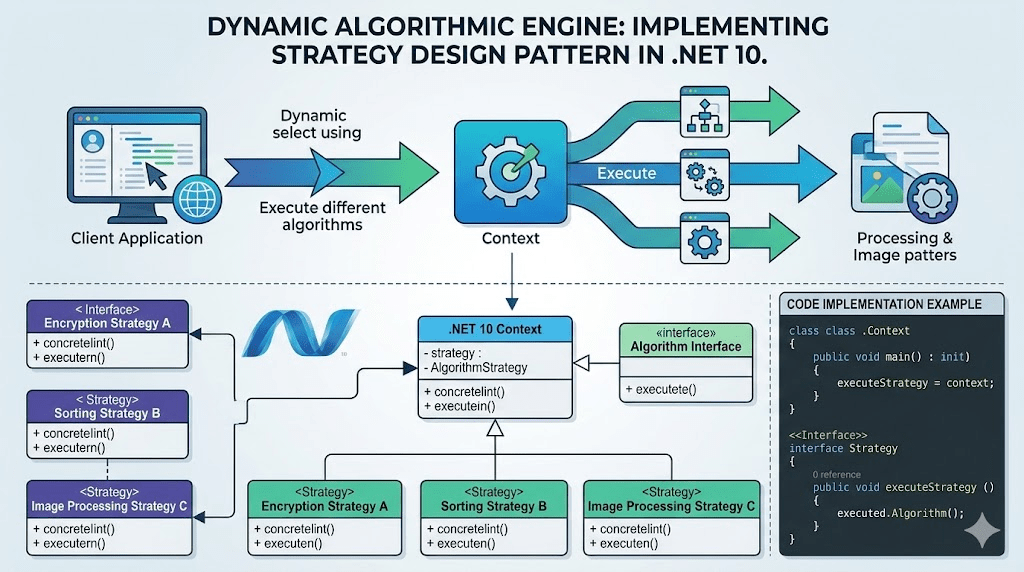
Image Credit – Gemini
Strategy Design Pattern is still a fundamental behavioral paradigm in contemporary software engineering. It offers the architectural framework that is needed to package exchangeable algorithms into a single execution environment. Applications can have dynamic runtime polymorphism by decoupling the definition of a strategy from the consumer of that strategy. This meets the Open/Close Principle, since it is possible to add new algorithmic behaviors without altering the underlying consumer class.
The development of the .NET ecosystem, especially the introduction of .NET 10 and C# 14, offers significant structural improvements to how this pattern may be imagined and achieved. The native Keyed Services of the Dependency Injection (DI) container, the contextual field keyword, the extension members, and the null-conditional assignments are the innovations that allow the software architects to build the strategy implementations that are syntactically leaner, highly performant, and deeply embedded within the core construct.
In order to strictly demonstrate these developments, this paper examines the design of a high-performance gaming system designed specifically to simulate and execute Blackjack. By simulating more complex forms of casinos as actual strategies that are based on the same interface, we can switch behavioral logic dynamically at run time, which gives a thorough exploration of the capabilities of the .NET 10 architecture.
The Mathematical Domain: Modeling Dealer Constraints
Before building the software pattern, it is necessary to create the domain logic that requires its existence. The dealer in the game of Blackjack does not have any human agency because his work is governed by strict procedural guidelines. The most significant procedural split in such rules is the definition and treatment of a soft 17 hand. These states have to be reflected correctly in the engine so that the strategy algorithms can determine the best course of action.
Distinguishing the Soft 17 and the Hard 17
The total of a hand is calculated by adding the number value of the cards that make up the hand. Face cards are valued at ten, and the Aces bring about complexity in that they have a loose value of one or eleven, which is better placed according to their ability to serve the hand with a maximum limit of twenty-one.
A Hard 17 is described as any hand that has a total of seventeen and does not have an Ace or has an Ace at which the Ace must be counted as one to ensure that the hand does not break. The peculiar feature of a hard hand is its stiffness; when you draw any card whose numerical value is five or more, you are bound to get an immediate bust.
Algorithmic Divergence: The H17 and S17 Strategies
There are two main behavioral approaches that casinos use towards the dealer about the Soft 17, which directly determine the algorithmic behavior that must be followed in the simulation engine. This variation of the rule changes the probability matrix of the whole game.
- Stand on Soft 17 (S17): The dealer is obliged to end his or her turn and stand on any amount of seventeen, whether it is composed or not. It is a strategy that restricts the capability of the dealer to enhance a very weak hand, which, by and large, increases the natural house advantage by a margin of 0.2%.
- Hit on Soft 17 (H17): The dealer is forced to take the next card when he has a Soft 17-hand, but is forced to stand when he has a Hard 17 or more. This is a mathematical risk-free chance to win a dominant overall, and this will boost the mathematical advantage of the casino by an approximate of 0.2%.
The information on whether the dealer is using an H17 or an S17 algorithm is the most important when a player is developing a mathematically perfect blackjack strategy. A player with an Ace should mathematically double up against a dealer with an H17, but a player with Hard 11 should simply hit against a dealer with S17. The algorithm of the dealer reinvents the optimal action of players.
Simulating Strategies via Reinforcement Learning
In building an elaborate engine to test such strategies, the architecture must be capable of processing Markov Decision Processes (MDPs) to simulate millions of programmatic hands. The engine can approximate the value of every possible decision by initializing episodes with random state-action pairs using techniques such as Monte Carlo simulation with Exploring Starts.
Moreover, the higher-order implementations employ Temporal Difference (TD) learning or Q-learning to come up with the best policies. The engine persistently recalculates its action-value operation using the Bellman equation:
$$Q(s_t, a_t) \leftarrow Q(s_t, a_t) + \alpha \left[ r_{t+1} + \gamma \max_a Q(s_{t+1}, a) – Q(s_t, a_t) \right]$$
Since the policy of the dealer is strictly determined by the active algorithmic strategy (H17 or S17), the engine must also have a mechanism that changes the object that defines the action space of the dealer immediately to ensure that the reinforcement learning models are trained appropriately to various environments. The need to have runtime polymorphism is absolute and culminates in the Strategy Design Pattern being implemented through Dependency Injection.
Architecting Runtime Polymorphism: Keyed Services in .NET 10
The Strategy Design Pattern is based on three different architectural elements: the Context, the Strategy Interface, and the Concrete Strategies. In earlier versions of the .NET system, dynamic replacement of implementations of a common interface was tedious. The common answer that developers use is injecting an IEnumerable<IStrategy> and using a manual loop through the collection, or worse still, using the Service Locator anti-pattern.
This architectural friction is eliminated by refinement of Keyed Services to become a first-class citizen in .NET 10. A native feature of Keyed Dependency Injection is that it allows developers to map several implementations of the same interface to unique identifiers, and thus register and resolve them.
Best Practices for Keyed Service Registration
The approach that is recommended in the architecture of .NET 10 is to use strongly-typed Enums to map the strategies, maintaining the type safety of the whole concept domain model. Since our dealer strategies are stateless mathematical algorithms, AddKeyedSingleton is the best lifecycle strategy.
// Defining the strategy interface
public interface IDealerStrategy
{
    void ExecuteHand(DealerContext context, IEnumerable<Card> hand);
}

// Registering the stateless algorithms as Keyed Singletons using Enums
builder.Services.AddKeyedSingleton<IDealerStrategy, StandOnSoft17Strategy>(DealerRuleset.S17);
builder.Services.AddKeyedSingleton<IDealerStrategy, HitOnSoft17Strategy>(DealerRuleset.H17);
Dynamic Resolution Techniques
In a dynamic gaming engine in which the active ruleset can be swapped in and out between simulated rounds without destroying the environment, solution via the IServiceProvider (or IKeyedServiceProvider) allows a seamless, in-flight solution.
public class DealerContext
{
    private readonly IServiceProvider _serviceProvider;

    public DealerContext(IServiceProvider serviceProvider)
    {
        _serviceProvider = serviceProvider;
    }

    public void ExecuteTurn(IEnumerable<Card> dealerHand, DealerRuleset currentRuleset)
    {
        // Dynamic runtime resolution based on the current game configuration
        var strategy = _serviceProvider.GetRequiredKeyedService<IDealerStrategy>(currentRuleset);
        strategy.ExecuteHand(this, dealerHand);
    }
}
This structure is ensured to provide clear architectural control and radically enhance unit testability by allowing precise mock substitution by key.
Structural Modernization via C# 14 Features
Keyed Services are used to optimize the macroscopic architecture, whereas the syntactical improvements made in C# 14 modernize the microscopic implementation of the domain models.
The Contextual field Keyword
Since the 1990s, .NET properties that had custom logic to be implemented in their accessors had to have developers declare a private supporting field. C# 14 is a response to this and has implemented the contextual field keyword. The compiler automatically generates a private backing field when used in the accessor of a property and removes the need to declare it.
public class Hand
{
    public bool IsBusted { get; private set; }

    public int TotalScore
    {
        get => field;
        set
        {
            field = value;
            if (field > 21)
            {
                IsBusted = true;
            }
        }
    }
}
Architectural Warning: When the gaming engine uses an ORM such as Entity Framework Core (EF Core) to store game states, a breaking change will arise as a result of refactoring the manual backing fields to the field keyword. EF Core uses reflection to find traditional names (e.g., _totalScore). The developers have to clearly ask the EF Core model builder to use the property accessors through UsePropertyAccessMode().
Fluid State Management via Null-Conditional Assignment
C# 14 permits the use of the operators,? and ?, to be used on the left-hand side of an assignment. This imposes a severe short-circuit test procedure: the right-hand side is run only when the left-hand receiver compiles to a non-null instance.
In extremely parallelized gaming engines, this operator simplifies mutation of safe states and natively accommodates compound assignments:
// Modifying a player's chip stack securely
activePlayer?.Bankroll += payoutAmount;

// Safely triggering a complex method only if the event bus is active
eventBus?.OnGameCompleted += HandleGameCompletion;
More importantly, this gives a one-evaluation guarantee, avoiding bugs that come about as a result of the evaluation of a side-effecting method in more than one run.
Domain Modeling with Extension Members
The extension members of C# 14 are a massive paradigm shift. Defining an extension(Type receiver) block now allows developers to easily add properties, indexers, and static factory members to types, including core framework generic collections.
The engine does not need to inflate a custom class to wrap a Hand: instead, it can simply extend the native IEnumerable<Card> directly:
public static class HandExtensions
{
    extension(IEnumerable<Card> cards)
    {
        public int BlackjackTotal
        {
            get
            {
                int total = cards.Sum(c => c.Value);
                int aces = cards.Count(c => c.Rank == Rank.Ace);

                while (total > 21 && aces > 0)
                {
                    total -= 10;
                    aces--;
                }
                return total;
            }
        }

        public bool IsSoft17 => BlackjackTotal == 17 &&
                                cards.Any(c => c.Rank == Rank.Ace) &&
                                cards.Sum(c => c.Value) > 17;
    }
}
Any normal set of cards could now be checked in real time by simply calling intuitive properties such as currentCards.IsSoft17 reduced cognitive load and created a very readable domain language.
Engine Initialization via Partial Constructors
In the past, it was problematic to separate the code of the initialization logic between an auto-generated file (as generated by a source generator) and a manually written developer file, since instance constructors could not be partial. C# 14 formally makes instance constructors and events partial members.
This enforces a rigid architectural separation: in one file is the defining declaration (a signature, no body), and in another file is the implementing one. This ensures the complex DI logic found in the developer is perfectly combined with the internal engine setup generated by the tooling.
The Integrated Blueprint: Executing the Concrete Strategies
Combining the strict domain rules with the advanced architectural possibilities of the .NET 10, the ultimate resultant engine structure will result in the total separation of concerns. Our C# 14 extension properties enable the algorithmic logic to be read like plain English instructions.
The S17 Strategy Implementation:
public class StandOnSoft17Strategy : IDealerStrategy
{
    public void ExecuteHand(DealerContext context, IEnumerable<Card> hand)
    {
        while (hand.BlackjackTotal < 17)
        {
            context.DealCardToSelf();
        }
        context.FinalizeHand();
    }
}
The H17 Strategy Implementation:
public class HitOnSoft17Strategy : IDealerStrategy
{
    public void ExecuteHand(DealerContext context, IEnumerable<Card> hand)
    {
        while (hand.BlackjackTotal < 17 || hand.IsSoft17)
        {
            context.DealCardToSelf();
        }
        context.FinalizeHand();
    }
}
Leveraging .NET 10 JIT Enhancements for Strategic Throughput
In the case of polymorphic concepts deployed in high-frequency loops of computation (as in the evaluation of millions of consecutive hands, in Q-learning), the virtual dispatch overhead of the framework is a major constraint.
Just-in-time (JIT) compiler has massive improvements introduced in NET 10. JIT dynamically uses Array Interface Devirtualization when an array or a span has been recreated behind an IEnumerable interface. It turns the interface methods into devitalized code and also inlines the logic to run directly into the hot path, which is why the C# 14 extension properties run at close to zero-allocation cost.
Moreover, the JIT models in .NET 10 prevent reordering difficulties as an asymmetric Traveling Salesman Problem with the mathematical 3-opt heuristic. This minimally lowers CPU cache misses and decreases latency over important execution paths. Combined with physical promotion optimization, which removes costly memory access by storing the struct members into hardware registers, these backend optimizations turn highly abstracted C 14 code into highly optimized machine instructions.
Conclusion
Combining the structural purity of the Strategy Design Pattern, the lean syntax of C# 14, and the powerful dependency injection features of .NET 10, software developers are empowered to develop scalable, dynamically flexible applications. The ensuing simulation engine demonstrates that extreme flexibility and extreme mathematical domain modeling can easily exist together without any loss in raw computational performance.